 |
I, Bonnie Carol, am a product of the great state of Texas where I spent my first sixteen and a quarter years. My interests as a kid presage my adult life: first, I was five when I first hiked into the Grand Canyon and as a kid I loved finding new swimming holes in the many Texas rivers as much as I enjoy exploring the mountains and rivers around my Colorado home now. I have always enjoyed leaping into new things and was always quick to say yes when a new adventure beckoned me. And my other great interest: music. I played piano from age four, accompanying my mother as she played (whether she wanted me to or not). As the years passed, I found myself the accompanist for the junior high school choir, the Austin, Texas, community theater’s musicals, and participating in classical piano contests. It was those 13 or so years playing piano that gave me my background in music. I still have the baby grand piano my grandmother gave me when I was 14 and my family was expecting that I’d be a concert pianist. However, when I was in my first year of college at Reed College in Portland, Oregon, the 60s folk boom was raging, and someone gave me a guitar. I also saw my first mountain dulcimer there at Reed, and although I studied my share of sex, drugs, rock and roll, as well as campus politics in college I somehow also got a degree and a few years of post graduate work in psychology and moved from Oregon to Colorado. The perfect education and rearing for a life-long resident of Dulci-topia, right? |
I began playing mountain dulcimer when my then-new sweetheart, Colorado guitar builder Max Krimmel, made me a dulcimer for Christmas, 1971. At the time, I was using that psychology education working in the Colorado mental health field but playing music in my spare time. Playing my folk-boom guitar and Christmas dulcimer came easily and most of my social life revolved around music with a generous helping of outdoor activities. I have always explored the landscape where I found myself, Texas, Oregon, and Colorado. But for a little early adventure, I spent my first summer away from the Texas family nest in Yellowstone National Park and San Francisco - that was 1963 when there were still Beatniks and before the Summer of Love. What follows is a summary of how all these trends fit together into a life. In 1972, funding in the mental health field underwent one of its intermittent cuts, and I lost my job of the time, working for a state mental hospital. About then one Max Krimmel had mystified me with the fact that he went to a lumberyard, bought boards, and made them into guitars. In just a few months we had driven to Alaska together via the (at that time) unpaved Alcan Highway, and were on the way to a stunning life together. I say this now as we celebrate five plus decades of adventures - our last big project was building a house with a 1000-square-foot music studio and a 1400-square-foot woodshop. When I lost my mental health job, professional guitar maker Max said, innocently enough, "I could show you how to make dulcimers for a living." And so began a saga: "Well trained mental health professional becomes gypsy musician and crafts person." I built a few dulcimers, sold them, and after a couple of years and 20 or so dulcimers, I thought, "Time to get a real job in the field where I am trained - psychology." But just before I launched this job hunt, I saw a notice in the 1975 Dulcimer Player's News about the first Kindred Gathering. Within days of attending the August, 1975 festival on the rainy Olympic Peninsula of Washington state, I executed an about face before I ever got to that ill-fated job hunt: I realized dulcimer players were the people with whom I wanted to spend the rest of my life. Psychology is a fascinating field, and playing music is a great pastime; most people would choose psychology as a vocation and play music as an avocation. I got it backwards: music vocation - psychology avocation. After that first Kindred Gathering took my heart away, I began doing whatever I could to make dulcimers into a decent living. I built dulcimers, wrote books, taught dulcimer and performed on the dulcimer, produced an all-dulcimer radio show at Boulder’s community public radio station, KGNU, named (what else?) Dulcimania, and I produced the 2nd annual Kindred Gathering here in Colorado, the only time it’s been off the west coast. Here’s where you can see how the dulcimers have evolved now that Max is the shop genius while I run the business: bonniecarol.com/builder.html In 1977 a Denver record company wanted to make a mountain dulcimer anthology recording, and I organized the Pacific Rim Dulcimer Project recording with the Kindred Gathering buddies. The recording is out of print, and Albert d'Ossché has passed on, but the rest of us are still in touch - Neal Hellman, Robert Force, Michael Rugg, Michael Hubbert, and me. Turns out after I made this recording, people began to imagine I was a musician so I began behaving as one: I toured these United States playing music for a decade or more. I went East first, and met the wonderful traditional music scene and the dulcimer players there - Maddie MacNeil, Keith Young, Phil Mason, etc. After my first trip to the Cosby dulcimer gathering, I began touring sequentially with friends David Schnaufer, Larkin Bryant, Mark Nelson and Doug Berch. Even more than I toured with others, I went solo. As I traveled, I met wonderful players from east and west, north and south, and I got the idea that they should all meet one another. I organized the 1979 Rabbit Junction Dulcimer Festival to accomplish this east-west dulcimer summit. The final festival scene was of Jerry Rockwell, Sally Rodgers, Mary Faith Rhodes, Ron Ewing, Leo Kretzner, Alan Freeman, Mark Nelson, Fred Meyer, Robert Force, Albert d'Ossché, Randy Wilkinson, Dorsey Williams, Baila Dworsky, Larkin Bryant, Willie Jaeger, Maddie MacNeil, Joellen Lapidus, Kevin Roth, David Schnaufer, Neal Hellman, and I singing Richard Fariña's Pack Up Your Sorrows on the festival stage. Another cherished memory was Al d'Ossché and Kevin Roth hanging on to each other and a big inner tube floating by the Rabbit Junction festival on Boulder Creek. East certainly did meet west, and I made more lifelong friends. During the late 70s and 80s, I spent about half of every year in Colorado, booking tours, playing in Colorado bands, and building more dulcimers. I had an uphill battle performing and teaching on the dulcimer in Colorado - I remember when the owner of a local coffeehouse where I hoped to perform asked me tentatively, "a whole evening of dulcimer music?" A memorable performing situation was the Bonnie (Carol) and Bonnie (Phipps) Generic All Purpose Folk Variety Show that all Bonnies could attend for free. And I played in a Celtic Band called Brendan at the local Irish pub, and played square dance and contra music for the local old time dances. For twenty years I performed with Colorado's Motherfolkers, a group of 10-15 women who put on the best-selling folk music show in Colorado once each year. After a 25-year run, the group called it quits, but we still seem to engage in the occasional reunion and benefit concert including in 2019 when the Motherfolkers were inducted into the Colorado Music Hall of Hame. In 1980 I recorded and wrote the book of music for my first solo mountain dulcimer recording, FINGERDANCES FOR DULCIMER. Since then there have been another half dozen books and recordings of mountain and hammered dulcimer - you can see all of these productions on that page of this web site. Each recording seems to define a particular era of life. bonniecarol.com/bookandrecord.html I don't remember exactly when it was, but probably I first saw a hammered dulcimer during these tours of the late 70s and early 80s. I do remember the first one that made an impression - I was performing in Dallas with Larkin Bryant and staying with hammered dulcimer player Dana Hamilton and his family. Dana taught me to play Paul VanArsdale's "Dulcimer Reel" on his hammered dulcimer and I was hooked. He offered to trade me a hammered dulcimer he had built for a mountain dulcimer I had built, and I was off and running in another new direction. That was probably in 1979. The dulcimer weighed 47 pounds as I recall - or maybe it was 47 pounds including the stand and a box of LPs (remember those?) I mostly learned to play hammered dulcimer on the streets of New York City - I found that with five or six songs and some LP's I could make a dependable $100-200 an hour in front of Trinity Church or the Metropolitan Museum of Art. I engaged in this work-study program for a month or so and next thing you know, I could play the hammered dulcimer tolerably. A lot of this success on the streets of New York could be attributed to my dulcimer - it was the four-string-per-course beauty built by Dana Hamilton which had the most beautiful and loud sound, and as I mentioned, it only weighed 47 pounds. I probably looked like someone's country cousin - I weighed only about twice as much as the dulcimer, and was I innocent! I remember a little old lady about 4 feet tall in the Wallstreet area learning over and whispering to me once, "Dear, you have too much money in your hat. Put some of it in your pocket." I found New Yorkers universally helpful and protective and still love to visit the Big Apple. 1986 brought my first solo hammered dulcimer recording, the concept recording, LAUGHING WILLOW. The concept? Why, travel and nature of course. I’ve benefitted greatly from the doors music and the dulcimer open for me. For example, I had some of my most memorable life experiences with the dulcimer in Central America. In 1988, I saw a notice in a local arts calendar about an arts brigade to Nicaragua. I was lured to Nicaragua with 10 or so other musicians, actors and visual artists. We dozen travelers spent a month in the country creating a play and concert with our Nicaraguan counterparts, also musicians, actors, and artists. We took the show all over Nicaragua to the community arts centers throughout the countryside. During the several weeks we were rehearsing in the capital city of Managua, we rented a house with a large front porch and word traveled through the music community of the city that we had music happening on the porch every evening. Musicians from all over the city would drop by and we would exchange culture and songs into the wee hours. I've never been the same - this experience enlarged on my early days growing up in Texas surrounded by the Tex-Mex border culture, and I have become interested in Tex-Mex conjunto music, marimbas, and music of the Caribbean, as well as the rest of Latin America. This experience in Latin America inspired my fourth recording, CELTIC CARIBE, not named for a New England basketball team, but for the Caribe Indians of Central America. It's more varied than previous recordings: I play both dulcimers, sing, play marimba, and congas. My next recording was also on the hammered dulcimer, THE VERY TOP OF THE TREE, and it covered the time when I got fascinated by river traveling and wrote a few songs about that experience to add to my enduring interest in traditional dance music of the British Isles and the US. All the time I was in Colorado recording and performing on the dulcimers, I was teaching dulcimer. Sometime during this time, in the 80s I suppose, computers took every field, even music, by storm. As difficult as it is for a musician to admit it, I enjoyed my time at the computer composing as well as transcribing music for my students. These computer transcriptions eventually became a half dozen books about the dulcimer.
|
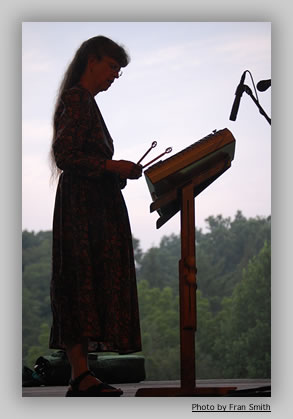
Something that is clear to me about adult students of music: they usually learn to play music because they want to play with others. This led me to add a distinctly social and group slant to my teaching. We learned to arrange in groups, we play for each other, and we performed in the Denver metro area as The Dulcimer Orchestra. In 2012 or so I left teaching, feeling that I had said what I had to say about how to play the dulcimer. That's the story of how I first heard of, built and played, recorded and taught dulcimers. It's been as much fun as anything I've ever done in this short life. And what a lovely community I've gotten to grow old in. Next, ask me about rafting the Grand Canyon half a dozen times with dulcimer in tow – another life-changing era. To this day, I search daily to find ways to be in the wilderness and be connected to the music community simultaneously. The first step was to get hired as the resident musician on a canoe trip on the Gunnison River in Colorado. Twenty of us river runners had seven fretted dulcimers, three hammered dulcimers, and two guitars, a raft, a bunch of canoes, and some great food which we took for three days of camping, hiking, canoeing, swimming, singing and playing songs around a campfire. It was enough fun that I started the yearly Moons and Tunes Wilderness River Trips – we gathered our instruments and our adventurous spirits every summer and did 4-5 day river trips on one of the many desert rivers of the West. Over the 21 years of the project, we did a total of 35 trips. Somewhere around 1,000 people and 75 guides participated before Max and I decided we had really done, and done again, that project and moved to end the project with a bang. That ending was 2019. Although the Moons and Tunes project has gone the way of delectable memories, I’m sure the canyons of the Colorado Plateau will call and I’ll be on another river before I depart this earth. Every time I see a photo someone has made in the Colorado Canyon country, the Colorado Plateau, the Grand Canyon and all the many runnable tributaries, I find myself wondering exactly where that photo was taken, and many times I can tell; that’s how familiar that whole area is to me. I love it like no other landscape. During this turn-of-the-20th-century era I was still playing and building dulcimers, amidst running rivers, hiking, cross country skiing, and exploring Zimbabwean music on marimba. On marimba, you may ask? Yet another instrument I have to explain? I guess it was a natural progression. I’ve always been interested in cultures different from the one from which I hail, and when I found Nicaraguan and Costa Rican musicians playing marimbas I thought, “I could do that!” Marimbas are, after all, a cross between the keyboards of piano and the percussion of hammered dulcimers. In Colorado I found not a Central American marimba scene, but rather an African one – specifically music of Zimbabwe. I traded marimba and hammered dulcimer lessons with a friend and before long we had started a Zimbabwean style marimba band named Chimanimani. After a several year run, Max built a set of the seven marimbas including the Giant Fan Bass (see MaxKrimmel.com for a description of building this bass) for our own studio here in Nederland, CO, and in the late 90s we began Zebra Marimba. Just as with the dulcimer, my music transcription and computer interests led me to write the marimba music down, and these half dozen marimba books are still available for sale. I taught several marimba classes over the years, and the last one became the Wild Okapi Marimba Ensemble. But then as happens with evolving artists, interests morphed. Max and I found we had experienced what we came for in marimbas and the last of our marimba ensembles moved out of marimba playing into a group of friends. Here’s some photos of the marimba era: bonniecarol.com/AfricanMarimba.htm While we were interested in all things African, we got the opportunity to join a friend in Botswana where one of the originators of the marimba music we played lived. From the capital city of Gaborone we traveled all over the bush of Botswana and met many local residents: lions, elephants, impala, kudu, crocodiles, and monkeys. In a Landrover we visited landscapes and animal habitats from the Kalahari Desert to the Zambezi River with a bushman guide. You can see the story and photos of this trip on this website at bonniecarol.com/Botswana/Africa/Gaborone.htm The year 2018 was a good one for Bonnie Carol Dulcimers: a little background, at some point in the 70s when I was touring I sold a dulcimer to dulcimer player and collector Anne Grimes of Ohio. When Anne passed away in 2015 she donated her dulcimer collection to the Smithsonian America History Museum. You may need to know that when I was young, before my teens, my parents took me to the Smithsonian and we spent roughly two weeks for several summers studying everything from early air travel to Dorothy’s ruby slippers from The Wizard of Oz. I loved the Smithsonian more than anything else in DC. As a ±10 year old I would never have imagined I would have the opportunity to have some piece of my life in their collection. It was an honor like no other when Anne Grimes’ dulcimer collection including Bonnie Carol dulcimer #103 took up residence at the Smithsonian American History. americanhistory.si.edu/collections/search/object/nmah_1819371. That same year, 1918, Max and I were invited to be part of a temporary exhibit of lutherie presented by the Colorado Music Hall of Fame and one of our guitars and one of our dulcimers were on display for a year or so. Then barely a year later, the magnificent Phoenix area Museum of Musical Instruments put one of our dulcimers on display and it is there today and in their Appalachian musical instrument exhibition, described in this Youtube by Curator Rich Walters.www.youtube.com/watch?v=x1MSNpvk6ls As these various projects and eras complete their time in my life, I wonder if maybe there’s another landscape, another activity, another project out there that I'll be so enthralled about as I have been about Moons and Tunes, dulcimer building, marimbas, touring, performing and teaching, etc. Sometimes you just have to clear the deck for something new to appear. New in my life so far in the early 21st century has been long distance bicycling (by long I mean 20-50 miles in a day - I am, after all, 74 years old here in 2020). In the last few years Max and I I have done multi-day trips on the 110-mile Mickelson Rail Trail through the Black Hills of South Dakota several times, the 230-mile Katy trail across Missouri along the Missouri River once, and the 14,000-foot Mt. Evans road twice the first summer of COVID. There have been many shorter daily rides and I’m loving learning to see the world from a bicycle. Max and I also continue our love of nordic skiing here in the Indian Peaks Wilderness Area of the Colorado Rockies and every Thanksgiving find ourselves waiting like children for Christmas for the local ski area to open. We’ll see how this evolves. In February 2019, Max and I celebrated our 50th un-iversary, 50 years of un-married bliss, by going to the Northern Canada to a wilderness lodge to see the Aurora Borealis. The northern lights were magnificent, but even more interesting to me was the lifestyle with ice roads across lakes (only usable in winter) and fully operational diamond mines as well as copious outdoor sports, all when it "warms up" to minus 30 degrees. During the COVID19 social isolation of 2019-2020 at age 74, I find myself working on a new recording of singing, mountain dulcimer, and Max playing guitar. In addition, I play up and down the Front Range of Colorado with a contra dance and concert band named Prairie Dog Picnic, that is, when there are dances and not viruses. Well … what a life so far. I have gotten to spend the majority of my lifetime engaged in pursuits that involve music and art, wilderness and travel, and that hopefully make our world a more sustainable and peaceful place. I believe fervently in the power of creativity, art, and connections with people to improve the world, and I continue to be delighted with many of these involvements. What a time! Addendum: now it is 2025 and I am 79 years old. I have come to think of life as a book with multiple chapters and we are definitely exploring a new chapter. We have retired from instrument building careers and have moved away from our 50+ years of mountain life. |
©Bonnie Carol 2025 * Bonnie@BonnieCarol.com * www.BonnieCarol.com * 4875 Sioux Dr. Apt. 008 * Boulder, Colorado 80303, 303-517-4255